Queanbeyan Showground: History, Heritage and Visitor Guide |
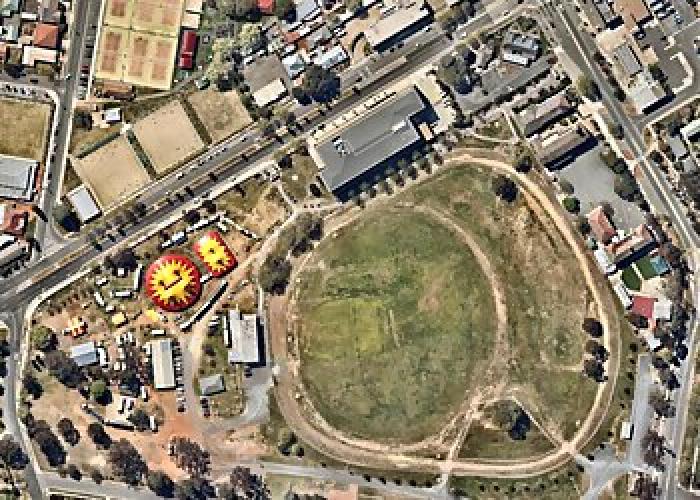
Queanbeyan Showground is far more than an agricultural show venue. The historic reserve near central Queanbeyan has served as an Aboriginal gathering and ceremonial place, recreation ground, racing venue and community meeting place, while its grandstand, Art Deco gates and agricultural buildings preserve more than a century of local history.
A place with a much older history
The history of Queanbeyan Showground begins long before agricultural shows, grandstands or racing tracks appeared on the site.The reserve has strong cultural significance for Aboriginal people as a traditional camping, gathering and ceremonial place used before and after European settlement. Historical and archaeological evidence also associates the area with Aboriginal burials.
During the 19th century, Aboriginal people continued to gather in Queanbeyan, with groups travelling from surrounding districts and considerably further afield. Historical records document large gatherings connected with the showground area, including visits by people from Braidwood, Yass and the Bland Plains and groups associated with the coast, lower Lachlan and Murrumbidgee regions.
Government blankets were distributed annually to Aboriginal people during this period, but the gatherings had a much broader cultural purpose. Corroborees and other ceremonial and social activities brought communities together, maintaining connections that pre-dated the colonial town.
A particularly important gathering took place in 1862. Historical accounts describe a corroboree lasting for weeks and attended by hundreds of Aboriginal people. Heritage records identify the present showground as an important location associated with these gatherings.
Archaeological discoveries have reinforced the site's significance. Human remains and Aboriginal objects have been reported in and around the reserve, including a burial encountered during construction of the grandstand in 1939. The remains were left in place and covered.
Today the continuing cultural connection between Aboriginal people and the showground is fundamental to understanding the significance of the reserve.
From recreation reserve to showground
Queanbeyan itself was officially proclaimed a township in 1838, when the settlement had a population of about 50. Government surveyor James Larmer laid out the original town on a square-mile street grid, with land on its south-western edge later becoming part of the showground.By 1862, most of the present reserve formed part of a much larger Recreation Ground set aside for Queanbeyan residents.
Agriculture subsequently gave the site another important role. In 1883, the Queanbeyan Pastoral, Agricultural and Horticultural Association secured the dedication of approximately 3.7 hectares of the Recreation Ground for showground purposes.
Agricultural shows were held there from this period, although the annual Queanbeyan Show in its established form dates from 1893. It developed into a major event on the district's social and agricultural calendar.
The reserve expanded again by about four hectares in 1906. After part of its north-eastern section was sold to the Catholic Church in 1920, proceeds from the transaction helped add a strip of land along the southern boundary. Council became trustee of the main showground and its Glebe Avenue extension in 1939.
The result is the distinctive, roughly triangular showground that remains close to the centre of Queanbeyan.
The grandstand and historic gates
Several surviving structures help tell the story of the showground's development during the first half of the 20th century.Among the most recognisable are the entrance structures dating from the 1930s. The Lowe Street entrance incorporates the Collett Memorial Gate, erected in 1934 in memory of Thomas Collett, a Queanbeyan businessman, council alderman and founding figure in the local agricultural association.
The entrance complex reflects the Art Deco architecture of the period. Its rendered masonry treatment and distinctive entrance arches make it considerably more elaborate than a purely functional showground gateway.
Architect Kenneth Oliphant designed work at the showground during this period, including additions to an earlier pavilion and the Art Deco ticket office and main entrance. The pavilion involved in that work was later destroyed by fire in 1974, but elements of the 1930s entrance survive.
The brick grandstand overlooking the arena dates from around 1939. Its covered seating, front walkway and ground-floor spaces form a prominent architectural feature of the reserve and provide a physical link with the era when agricultural shows and racing attracted large crowds.
Other structures recorded in heritage studies illustrate how extensively the grounds developed. These have included sheep pens dating from 1918, a poultry pavilion from 1939, a public bar dating from 1936-37, cattle and horse stalls built in 1951 and later Show Society facilities.
A showground built around racing
Agricultural competition was only one part of Queanbeyan Showground's story. For decades, racing was central to activity on the grounds.Trotting became a popular component of the Queanbeyan Show, prompting the development of a dedicated harness-racing track in the 1920s. The showground subsequently became an important venue for regular trotting meetings in New South Wales, with racing continuing there until 1968.
Greyhound racing added another dimension. A coursing track was developed during the early 1930s, beginning a lengthy association between the showground and the sport.
The former tracks changed the physical character of the grounds as well as the entertainment available there. Heritage documentation from the 2020s notes that the trotting and coursing tracks are no longer in place or operating, but their history remains an important part of the reserve's evolution.
The showground has hosted a surprisingly broad range of other activities, including circuses, carnivals and poultry exhibitions. At the outbreak of the Second World War, the Canberra troop of light horse used the grounds for drilling.
The reserve has even played a practical role during local emergencies, serving on occasions as an emergency caravan area when flooding affected Queanbeyan.
The fight to retain the showground
By the 1970s and 1980s, the future of Queanbeyan Showground had become increasingly contentious.Its proximity to the commercial centre of Queanbeyan made the land attractive for redevelopment. In 1988, council development proposals triggered substantial community opposition.
The campaign brought together organisations with very different interests but a common desire to retain the reserve. They included the Show Society, Ngunnawal Land Council, Queanbeyan and District Historical Society, Monaro Conservation Society, racing interests and the specially formed Friends of Queanbeyan Showground.
The dispute intensified after 24 lots along Glebe Avenue were resumed in 1989. Community action ultimately led to the New South Wales Legislative Council disallowing the resumption.
The episode became an important chapter in the modern history of the site. Rather than disappearing beneath redevelopment, the showground remained an open community and events space.
Heritage significance
Queanbeyan Showground is entered on the NSW State Heritage Register, reflecting significance extending well beyond its surviving showground architecture.Its Aboriginal cultural values are particularly important. Heritage assessments recognise it as a rare, well-documented Aboriginal ceremonial and camping place that continued to be used during the 19th century following European settlement.
The documented 1862 gathering provides valuable historical evidence about Aboriginal ceremonial life at a time when colonial expansion was rapidly transforming the surrounding region. Oral tradition, historical accounts, archaeological finds and recorded burials collectively demonstrate a longstanding connection with the place.
The reserve also illustrates the development of Queanbeyan itself. Its origins as part of the town's Recreation Ground reveal 19th-century approaches to public open space, while its subsequent agricultural, sporting and entertainment uses chart changes in community life over generations.
Its grandstand and original entrance features add architectural significance, while the continuing use of the land as a showground maintains an important connection between the historic landscape and its modern purpose.
Queanbeyan Show and community events
The agricultural tradition continues through the annual Queanbeyan Show, while the showground also hosts the Queanbeyan Rodeo.Its large open spaces mean the reserve can accommodate activities that would be difficult to stage in a conventional hall or urban park. Contemporary uses include festivals, markets, car shows and horse and animal events.
The grounds have consequently retained the adaptable character that has defined them for much of their history. Agricultural exhibitions, racing, entertainment, community gatherings and major outdoor events have all occupied the same central space at different times.
That versatility has also encouraged investment in contemporary facilities without abandoning the historic setting.
A new pavilion for the showground
A significant upgrade was completed in April 2025 with the delivery of a new showground pavilion and associated works.The main pavilion construction was substantially completed during 2024, followed by internal works providing toilets, lighting, electrical connections and water and sewer services. A concrete slab at the Cameron Road end and surrounding landscaping followed in 2025.
The external pavilion project was valued at $718,000, with a further $250,000 allocated for internal works. Funding included $600,000 from the NSW Government's Stronger Country Communities Fund, $100,000 from Queanbeyan-Palerang Regional Council and $18,000 raised by Friends of the Showground and Jerrabomberra Rotary.
The investment reflects the continuing role of the reserve as a working community venue rather than a heritage place preserved solely for its historic associations.
Visiting Queanbeyan Showground
Queanbeyan Showground is at Glebe Avenue, Queanbeyan NSW 2620, close to the city centre.Facilities listed by Queanbeyan-Palerang Regional Council include accessible amenities, parking, power, lighting, kitchen facilities, bins, toilets and showers and Wi-Fi. The venue is available for private and public events, with bookings managed through council.
Visitors should remember that this is both an active events venue and a place of considerable cultural and historical importance. Its significance stretches from Aboriginal ceremonial gatherings and burial associations through the rise of the agricultural show movement, the racing era and the community campaign to preserve the reserve.
Few surviving features tell the entire story by themselves. It is the continuity of the place - an open gathering ground that has repeatedly adapted to changing generations and purposes - that makes Queanbeyan Showground such an important part of Queanbeyan's cultural landscape.
❊ Address ❊
⊜ Glebe Avenue Queanbeyan 2620 View Map
✆ Telephone: (02) 6123 1234
❊ More Information ❊
→
www.facebook.com
Tags: Queanbeyan Showground, Queanbeyan Show, Queanbeyan Rodeo, Queanbeyan history, Queanbeyan heritage, NSW showgrounds, Queanbeyan attractions, Queanbeyan events, Queanbeyan NSW
Update Page